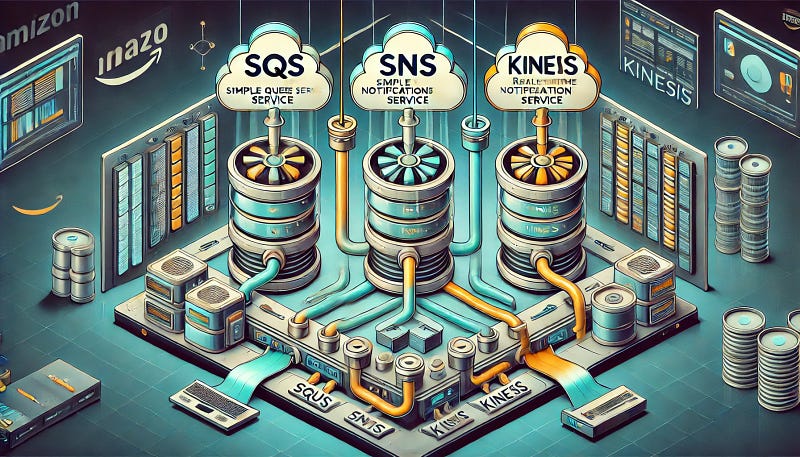
🚀 The Cloud’s Messaging Power Trio: Amazon SNS, SQS, and Kinesis
📡 The Nervous System of Modern Cloud Applications
Imagine you’re running a global news network. Every second, breaking news stories arrive from different sources. Some updates need to be sent instantly to millions of people (push notifications), while others must be stored and processed carefully before release (queuing). Then, there are massive live data feeds, like social media trends, that need to be analyzed in real-time.
This is exactly how Amazon SNS, SQS, and Kinesis function in cloud applications — ensuring that messages, events, and data are delivered, stored, and analyzed effectively.
By the end of this guide, you’ll understand:
✅ Amazon SNS — The Broadcaster 📢
✅ Amazon SQS — The Reliable Queue 📬
✅ Amazon Kinesis — The Data Streamer 🔄
✅ How they work together & when to use which
✅ Key takeaways for AWS exams 🎯
✅ Service Constraints & Limitations ⚠️
📢 Amazon SNS — The Mass Broadcaster
What is SNS?
Amazon SNS (Simple Notification Service) is like a public announcement system 📢. It allows you to send messages to multiple subscribers at once, whether they’re people (via SMS/email) or AWS services (via Lambda/SQS/HTTP).
How SNS Works:
1️⃣ A publisher (e.g., an application or microservice) sends a message to an SNS Topic.
2️⃣ SNS distributes the message to all its subscribers (email, Lambda, SQS, HTTP, SMS).
3️⃣ Each subscriber processes the message differently (a mobile push notification vs. an automated database update).
Why Use SNS?
✅ Push-based messaging — Unlike polling, subscribers don’t need to check for new messages.
✅ Multiple delivery methods — Works with email, SMS, HTTP endpoints, AWS Lambda, and SQS.
✅ Scales automatically — Can handle millions of messages per second.
📌 Try It: Create an SNS Topic, subscribe an email, and send a test notification.
🔄 SNS + SQS — The Fan-Out Pattern
When multiple systems need the same message but process it differently, SNS fans out messages to multiple SQS queues.
Example: E-Commerce Order Processing 🛒
1️⃣ A customer places an order → SNS publishes an event.
2️⃣ SNS fans it out to different SQS queues:
📦 Shipping queue (for order fulfillment).
💳 Billing queue (for payment processing).
📧 Email queue (for confirmation emails).
Why Use Fan-Out?
✅ Prevents bottlenecks — Each service works independently.
✅ Ensures reliability — If the shipping system is down, billing still works.
✅ Highly scalable — Works for large event-driven applications.
📌 Try It: Set up an SNS Topic with multiple SQS queues as subscribers.
🔄 Amazon SQS — The Message Queue That Never Forgets
What is SQS?
Amazon SQS (Simple Queue Service) is like a post office for applications 📬. It stores messages until a system is ready to process them, ensuring that no message is lost.
How SQS Works:
1️⃣ A producer (application, Lambda, API) sends a message to an SQS queue.
2️⃣ The message stays in the queue until a consumer retrieves it.
3️⃣ Once processed, the message is deleted from the queue.
Key Benefits of SQS:
✅ Decouples services — Prevents direct dependency between components.
✅ Ensures message durability — Messages are stored for up to 14 days.
✅ Supports FIFO (First-In, First-Out) processing — Ensures ordered message delivery.
📌 Try It: Create an SQS queue, send messages, and process them with AWS Lambda.
🔗 Amazon Kinesis — The Real-Time Data Powerhouse
Imagine processing millions of live data points from IoT sensors, financial transactions, or website analytics in real-time. That’s where Kinesis comes in.
How Kinesis Works:
🔹 Kinesis Data Streams — Ingests and processes real-time streaming data.
🔹 Kinesis Data Firehose — Delivers streaming data to S3, Redshift, or Elasticsearch.
🔹 Amazon Managed Service for Apache Flink — Analyzes streaming data in real-time.
📌 Try It: Create a Kinesis Data Stream, send live data, and visualize it in S3.
🚀 The Future of Event-Driven Architecture
Amazon SNS, SQS, and Kinesis form the backbone of scalable, event-driven cloud applications. Whether you’re handling notifications, queuing messages, or processing live data streams, AWS has a powerful solution for every scenario.
💡 Want to build event-driven apps that scale effortlessly? Start mastering these services today! 🚀
💬 Which AWS service do you use the most? Let’s discuss in the comments! 👇